Messaging & Voice
How we write says as much about RPGMotor Works as how we look. These four principles apply to everything we publish, from a datasheet to a social post.
Section 3 of 28. 2 files to download.
How we sound in writing
- Be precise
Be precise – Engineers read our copy, and they want facts. Give the number, the unit and the condition: "2.4 Nm continuous torque at 40 °C ambient" tells a buyer far more than "high torque." If you don't have the figure, ask product management rather than guess or round it.
Spell out acronyms on first use
Our industries run on acronyms, and not every reader knows them. Spell out a term the first time it appears, followed by the short form in parentheses: brushless DC (BLDC), electric vehicle (EV), sales and operations planning (S&OP). Use the short form after that. Leave internal shorthand, such as plant codes, out of anything a customer will read.
- Be plain
Be plain – Write the way a good application engineer talks to a customer: short sentences, common words, active voice. Say "use," not "utilize," and "helps," not "facilitates." If a sentence has to be read twice, rewrite it.
- Be useful
Be useful – Every piece of copy should help the reader do something: choose a motor, size a drive, book a service visit or reach the right person. Lead with what the reader needs, then add the detail. Put the part number, phone number or next step where it is easy to find.
- Be confident, not loud
Be confident, not loud – We've built motors since 1958, and we don't need to shout. Let test data, customer results and certifications make the case. Avoid superlatives such as "best," "revolutionary" or "unmatched," and never criticize a competitor by name.
How we sound when we write
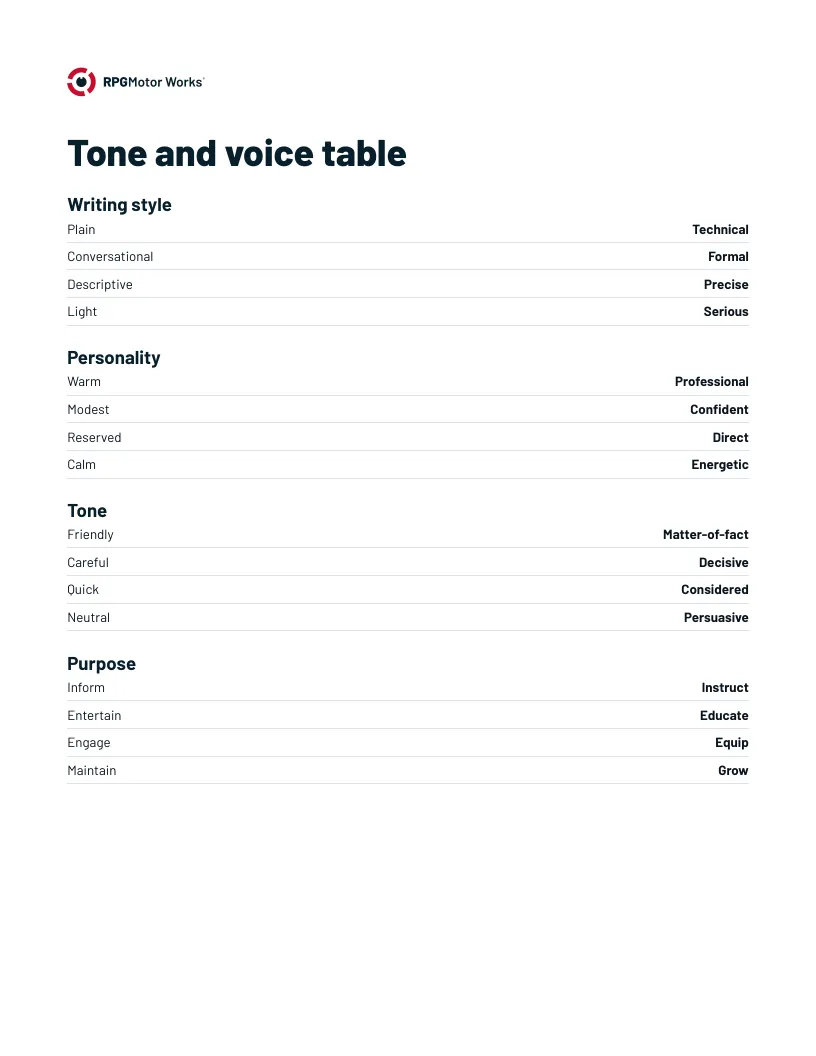
From RPG Tone and Voice Table.pdf. Each row runs from less to more; the word on the right is where RPGMotor Works sits.
Writing style
Personality
Tone
Purpose
Files
Editable Table
1 file